8 (2), 2026
 .
.
Cover & Editorial Board
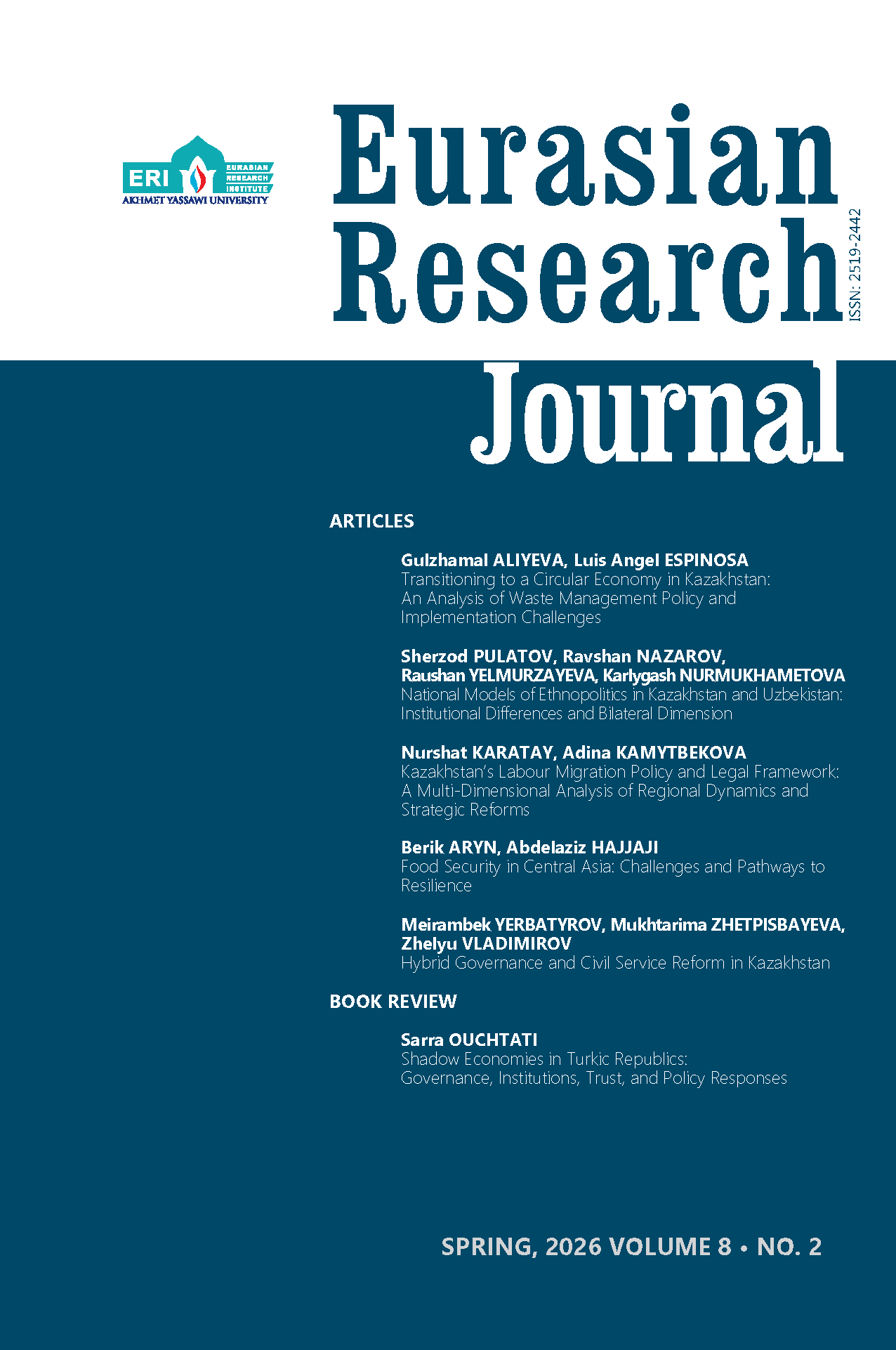
Gulzhamal ALIYEVA & Luis Angel ESPINOSA
TRANSITIONING TO A CIRCULAR ECONOMY IN KAZAKHSTAN: AN ANALYSIS OF WASTE MANAGEMENT POLICY AND IMPLEMENTATION CHALLENGESThis article analyses Kazakhstan’s waste management policy in the context of increasing global environmental challenges and the country’s transition to a circular economy. Methodologically, the study employs qualitative document analysis of the post-2021 governance framework, including laws, subordinate acts, policy programmes, and official institutional materials. It is complemented by descriptive analysis of official statistics, and the findings are synthesised through a SWOT framework. The analysis highlights that, despite regulatory modernisation following the 2021 Environmental Code, implementation remains uneven due to infrastructure gaps, weak incentives, limited citizen participation, and persistent data inaccuracies. Particular attention is paid to municipal solid waste and e-waste, with municipal-level dynamics illustrated through the Astana waste management programme (2024–2028). The SWOT-based discussion links these constraints to policy priorities, including digitalisation of waste-flow accounting and registers, strengthened local implementation capacity, enforcement, and investment- oriented instruments to expand sorting and recycling.
Keywords: Waste management, Kazakhstan, Circular economy, Public policy, Municipal waste.
DOI : https://doi.org/10.53277/2519-2442-2026.2-01 [HTML]
NATIONAL MODELS OF ETHNOPOLITICS IN KAZAKHSTAN AND UZBEKISTAN: INSTITUTIONAL DIFFERENCES AND BILATERAL DIMENSIONThis article provides a comparative institutional analysis of national ethnopolitical models in Kazakhstan and Uzbekistan within the context of bilateral interaction. The empirical framework draws on legal documents, official statistics on ethnic composition and settlement patterns, and data on ethnocultural and educational infrastructure. The findings reveal that, despite similar multiethnic structures, the two countries diverge in their institutional logic of ethnic inclusion. Kazakhstan demonstrates a more formalized and representative model, while Uzbekistan relies on centralized administrative coordination and cultural integration. The study identifies three stages in the evolution of Kazakh–Uzbek relations, emphasizing the post-2017 phase marked by intensified institutionalization of humanitarian and ethnocultural cooperation. Attention is paid to the role of cross-border ethnic communities and humanitarian initiatives in mitigating latent conflict risks. The results contribute to understanding how institutional design shapes interethnic stability and offer practical insights for enhancing interethnic harmony and bilateral cooperation in Central Asia.
Keywords: Ethnopolitics, National model, Institutional analysis, Kazakhstan- Uzbekistan relations, Central Asia
DOI : https://doi.org/10.53277/2519-2442-2026.2-02 [HTML]
KAZAKHSTAN’S LABOUR MIGRATION POLICY AND LEGAL FRAMEWORK: A MULTI-DIMENSIONAL ANALYSIS OF REGIONAL DYNAMICS AND STRATEGIC REFORMSLabour migration in Kazakhstan has gradually evolved from an unstructured mechanism of economic adaptation into a more formalised component of national policy. This article examines the institutional and legal framework of migration governance through an analysis of Kazakhstan’s migration policy concepts and regulatory mechanisms. Particular attention is given to the foreign labour quota system, preferential migration arrangements for nationals of the Eurasian Economic Union, and the emergence of relocation migration following recent geopolitical developments. The study also analyses regulatory distinctions between corporate and individual labour migration and considers the broader regional dynamics of labour mobility in Central Asia. In addition, the article explores the role of bilateral labour agreements and international organizations in shaping migration governance and protecting the socio-economic rights of migrant workers. Despite ongoing reforms, informal labour practices continue to limit the effectiveness of state regulation. The findings suggest that Kazakhstan’s migration policy aims to balance labour market protection with the need to attract qualified foreign labour.
Keywords: Kazakhstan, Relocants, Migration policy, Ethnopolitical stability, Eurasian integration
DOI : https://doi.org/10.53277/2519-2442-2026.2-03 [HTML]
FOOD SECURITY IN CENTRAL ASIA: CHALLENGES AND PATHWAYS TO RESILIENCEFood security is a complex challenge in Central Asia, impacted by climate change, water scarcity, land degradation, and disconnected governance systems. Although the region has high agricultural potential, particularly in cereals and irrigated agriculture, food security conditions differ across countries. This research explores the major issues underlying food security in Central Asia, including limited agricultural land, production trends, socio-economic vulnerabilities, and policy context. It also identifies systemic weaknesses, including inconsistencies across agriculture, water, and energy policies. At the same time, it highlights opportunities to strengthen food system resilience through better data, early warning systems, climate-smart agriculture, sustainable water governance, regional cooperation, and stakeholder engagement. This work adopts a qualitative comparative analysis based on national strategies, official government reports, and academic literature. The findings recommend a regional roadmap for long-term food security and conclude that strengthening regional coordination, improving water governance, and investing in climate-resilient agriculture are essential for Central Asia.
Keywords: Food security, Central Asia, Climate change, Water governance, Regional cooperation
DOI : https://doi.org/10.53277/2519-2442-2026.2-04 [HTML]
HYBRID GOVERNANCE AND CIVIL SERVICE REFORM IN KAZAKHSTANThis study examines the hybridization of Kazakhstan’s civil service through the integration of career-based and position-based governance principles. Using regional administrative data from twelve territorial departments of the Agency of the Republic of Kazakhstan for Civil Service Affairs, two quantitative indicators, the external inflow share and the source balance index, were developed to measure institutional permeability and recruitment diversity. Statistical and cluster analyses revealed significant regional disparities in the degree of hybridization, with economically advanced regions demonstrating greater openness to external talent. The strong correlation between external inflow shares and source balance index confirms a systemic link between administrative openness and structural adaptability. The findings contribute to the empirical operationalization of hybrid governance and provide evidence-based insights for refining recruitment strategies and promoting institutional modernization within Kazakhstan’s public administration.
Keywords: Hybrid governance, Civil service reform, Institutional adaptability, Recruitment diversity, Kazakhstan
DOI : https://doi.org/10.53277/2519-2442-2026.2-05 [HTML]
Book Review: SHADOW ECONOMIES IN TURKIC REPUBLICS: GOVERNANCE, INSTITUTIONS, TRUST, AND POLICY RESPONSES